Mucopolysaccharides
Clinical Biochemistry
Background Information
The mucopolysaccharidoses are a group of lysomomal storage disorders characterised by the accumulation of glycosanimnoglycans, which are subsequently excreted in the urine.
The glycosaminoglycan (GAG)/creatinine ratio is the first line screening test for MPS disorders; 2D GAG electrophoresis will then be reflexed by the laboratory when required.
Attenuated forms may be difficult to detect by urine screening, in which case if there remains a high index of clinical suspicion it may be necessary to proceed to enzyme testing.
Patient Preparation
No specific preparation required.
Sample requirements
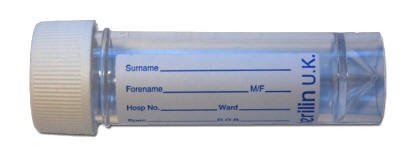
5 mL early morning urine. Sample must be adequately concentrated, with urine creatinine >1 mmol/L for analysis; dilute or insufficient samples can result in false negatives, and therefore in these cases a repeat sample will be requested initially. Samples should be collected into a white top Universal
Storage/Transport
Send at ambient temperature to the laboratory. If unavoidable, urine samples should be kept refrigerated and sent to the laboratory as soon as possible after collection. Note: bacterial degradation can cause false negative results.
Required information
Relevant clinical details, including any relevant drug or dietary history, learning difficulties, autism or dysmorphic features.
Turnaround times
Samples are referred to an external laboratory for analysis with results expected back within 14 days (28 days for reflexed 2D GAG electrophoresis).
Reference ranges/Therapeutic Ranges
Ranges and interpretation reported as provided by referral laboratory.
Further Information
To learn more visit the website of The National Metabolic Biochemistry Network, also visit the MPS Society webpage.
Page last updated: 01/07/2026 | Page last reviewed: 01/07/2026